levain (levain) Levain
levain (levain)
A levain (levain) (PHÁT TRIỂN LUH-VOHN), CŨNG được gọi là men, được làm từ một phần nhỏ của bánh mì men tự nhiên (sourdough) men cái sourdough (starter), và như bạn có thể đoán từ tên của nó, nó chịu trách nhiệm tạo men cho khối bột (dough) của bạn (làm cho nó nổi lên). Đó là quá trình lên men trước, về cơ bản có nghĩa là bột mì được lên men trước khi trộn vào khối bột (dough) (và không giống như men cái sourdough (starter) của bạn, toàn bộ levain (levain) bạn tạo ra sẽ được sử dụng). levain (levain) giúp bạn đảm bảo khối bột (dough) của bạn sẽ bắt đầu lên men với quần thể vi khuẩn có lợi và nấm men hoang dã mạnh mẽ, đồng thời nó cũng cho phép bạn điều chỉnh tỷ lệ giữa hai loại này (xem Nghiên cứu về chua, trang này ). Khi trộn vào khối bột (dough) chính, levain (levain) tạo hạt giống khi quá trình lên men bắt đầu. Những vi khuẩn này chịu trách nhiệm tạo men cho khối bột (dough), mang lại cho nó chất lượng bảo quản đặc biệt và tạo ra phần lớn hương vị cho ổ bánh mì cuối cùng (nhờ các sản phẩm phụ của quá trình lên men tự nhiên).
Tại sao lại tạo levain (levain)?
Nếu bạn có bánh mì men tự nhiên (sourdough) men cái sourdough (starter) được bảo trì tốt thì việc tạo levain (levain) không bắt buộc phải thực hiện (bạn luôn có thể chỉ cần sử dụng men cái sourdough (starter)!). Tuy nhiên, tôi đã học cách nướng bánh mì bánh mì men tự nhiên (sourdough) bằng cách sử dụng levain (levain) cho mỗi lần nướng và qua nhiều năm, tôi nhận thấy việc những người thợ làm bánh tại nhà tạo thói quen làm một chiếc bánh cho một món nướng cụ thể sẽ hữu ích biết bao. levain (levain) phục vụ một số mục đích:
Nó có thể được sử dụng để thay đổi hương vị, kết cấu và khối lượng tiềm năng của ổ bánh mì cuối cùng mà không cần phải sửa đổi bánh mì men tự nhiên (sourdough) men cái sourdough (starter) của bạn.Hãy coi nó như một men cái sourdough (starter) được tạo riêng cho mỗi công thức bạn bắt tay vào. levain (levain) có thể làm lệch đặc điểm hương vị của bánh mì theo hướng chua hơn hoặc ít chua hơn bằng cách thay đổi “thông số xây dựng” của nó: loại bột được sử dụng, tỷ lệ cấy hoặc tỷ lệ hạt (lượng men cái sourdough (starter) chín được sử dụng để tạo ra levain (levain)), thời gian chín và nhiệt độ của nó. Tôi cũng thích việc nó giúp các công thức nấu ăn của tôi nhất quán với những người làm bánh khác: Vì mọi người duy trì (và đôi khi bỏ bê!) phần khởi đầu của họ theo đủ mọi cách, nên việc xây dựng levain (levain) có nghĩa là tất cả chúng ta đều bắt đầu trên cùng một trang.
Nó có thể được sử dụng để mở rộng quy mô lên men trước để đáp ứng các yêu cầu về công thức nấu ăn.Nếu công thức nấu ăn của bạn yêu cầu một lượng lớn quá trình lên men trước, levain (levain) cho phép bạn mở rộng quy mô lên men trước trong một bước duy nhất để đáp ứng các yêu cầu của công thức. Một số thợ làm bánh thích giữ men cái sourdough (starter) nhỏ hơn nhiều (xem Duy trì men cái sourdough (starter) nhỏ hơn,trang này), do đó levain (levain) giúp thu hẹp khoảng cách giữa men cái sourdough (starter) nhỏ, được duy trì liên tục và yêu cầu lên men trước của công thức nấu ăn.
Vì levain (levain) được trộn trong một lọ nhỏ riêng biệt nên bạn sẽ không vô tình sử dụng hết men cái sourdough (starter)—và có thể quên làm mới nó.Đây có lẽ là một mối quan tâm nhỏ đối với một số người, nhưng tôi thích giữ riêng quá trình lên men trước cho món nướng trong ngày. Ngay sau khi tôi sử dụng men cái sourdough (starter) chín muồi của mình để tạo levain (levain), tôi làm mới men cái sourdough (starter) của mình và cất nó đi trong thời gian còn lại trong ngày.
TẠO levain (levain)
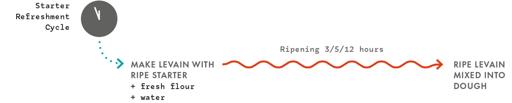
men cái sourdough (starter) Chu trình giải khát (xem trang này )
levain (levain) so với men cái sourdough (starter): Sự khác biệt là gì?
bánh mì men tự nhiên (sourdough) men cái sourdough (starter) và levain (levain) về cốt lõi đều giống nhau: Cả hai đều là những chất lên men trước.
Tuy nhiên, có một vài khác biệt chính. Trong cuốn sách này, tôi sử dụng thuật ngữ “men cái sourdough (starter)” để chỉ văn hóa bánh mì men tự nhiên (sourdough) được duy trì liên tục của tôi. Một số người có thể gọi đây là đầu bếp của họ, đức tin của bà , văn hóa mẹ, mẹ, mẹ khối bột (dough), v.v. men cái sourdough (starter) của tôi không bao giờ được sử dụng hoàn toàn trong lò nướng vì khi đó tôi sẽ không còn gì để tiếp tục nhân giống nó. Nó đang trong một chu kỳ chín liên tục, trong đó nó được làm mới và để lên men một thời gian cho đến khi chín trở lại, tại thời điểm đó, nó có thể được sử dụng để trộn vào khối bột (dough) hoặc tạo levain (levain) mới hoặc có thể được làm mới để tiếp tục chu kỳ.
Mặt khác, levain (levain) được tạo ra bằng một phần của bánh mì men tự nhiên (sourdough) men cái sourdough (starter) chín, để lên men trong một thời gian, sau đó được sử dụng toàn bộ trong khối bột (dough) trộn vào ngày hôm đó. Vì nó là một nhánh từ bánh mì men tự nhiên (sourdough) men cái sourdough (starter) và được tạo ra cho một lần sử dụng nên nó có thể được sử dụng để điều chỉnh các đặc tính lên men (ví dụ: tăng hoặc giảm độ chua).
| bánh mì men tự nhiên (sourdough) men cái sourdough (starter) | levain (levain) (LEAVEN) |
| Lên men trước | Lên men trước |
| Văn hóa liên tục, được làm mới thường xuyên | Dùng một lần cho một lần nướng |
| Thường được làm mới bằng cùng loại bột và giữ ở cùng nhiệt độ | Có thể là bất kỳ sự kết hợp bột nào và nhiệt độ có thể thay đổi |
| Hầu hết các đặc tính nhất quán (độ axit/hương vị) vì nó được duy trì một cách nhất quán | Có thể dùng để thay đổi hương vị và kết cấu của một lô khối bột (dough) |
Tôi có thể chỉ sử dụng bánh mì men tự nhiên (sourdough) men cái sourdough (starter) của mình thay vì tạo levain (levain) không?
Tất cả các công thức nấu ăn trong cuốn sách này đều sử dụng levain (levain) chuyên dụng vì những lý do đã được thảo luận (để điều chỉnh cấu hình hương vị, sửa đổi thời gian nướng và tăng quy mô lên men trước), nhưng nếu bạn quên tạo levain (levain) và Thực ra muốn nướng, chỉ cần sử dụng men cái sourdough (starter) chín của bạn! Điều đó có nghĩa là một cấu hình hương vị khác nếu levain (levain) có cấu trúc khác biệt đáng kể (bột khác, tỷ lệ nước (hydration) và nhiệt độ), nhưng tốt hơn là không nướng chút nào. Chỉ cần đảm bảo rằng bạn không sử dụng toàn bộ bánh mì men tự nhiên (sourdough) men cái sourdough (starter) trong quá trình nướng bánh—như thường lệ, hãy tiết kiệm một chút để duy trì văn hóa của bạn.
Tôi nên sử dụng loại bột nào cho levain (levain) của mình?
Bất kỳ loại bột lên men nào cũng có thể được sử dụng để làm levain (levain), từ lúa mì trắng, lúa mì nguyên hạt đến các loại ngũ cốc như lúa mì đánh vần, einkorn hoặc Khorasan. Tôi có một loạt các lựa chọn bột mì phù hợp, tùy thuộc vào kết quả mong muốn của tôi cho levain (levain) và mỗi lựa chọn mang lại các thuộc tính khác nhau cho levain (levain), khối bột (dough) cuối cùng và sau đó là ổ bánh mì thành phẩm. Lưu ý rằng ổ bánh mì thu được sẽ không có mùi vị giống như levain (levain); nó chỉ đơn giản là hạt giống để bắt đầu quá trình lên men.
Nói chung, tôi thích levain (levain) của tôi có ít nhất 50% ngũ cốc nguyên hạt. Việc kết hợp bột mì nguyên hạt với bột mì trắng đã rây sẽ tạo ra levain (levain) cân bằng với hương vị phong phú và khả năng tạo men. Việc thêm bột ngũ cốc nguyên hạt cho phép levain (levain) hấp thụ nhiều axit hơn trước khi hoạt động của vi khuẩn giảm xuống, điều này có nghĩa là tổng lượng axit hữu cơ và các hợp chất hương vị khác sẽ tăng lên. Bột mì trắng 50% cân bằng toàn bộ lúa mì, giữ cho lúa mì nhẹ hơn bằng cách ngăn không cho độ axit tăng quá mạnh. Tất nhiên, bạn cũng có thể sử dụng một trong hai đầu của quang phổ: bột mì trắng 100% levain (levain) (giống như bột mì trong Bánh mì Sandwich trắng mềm, trang này ) dẫn đến độ axit giảm đáng kể, trong khi 100% ngũ cốc nguyên hạt levain (levain) (giống như loại có trong 100% lúa mì nguyên hạt, trang này ) mang lại độ axit và hương vị phức tạp hơn.
Khi nào levain (levain) sẵn sàng để sử dụng?
Giống như bánh mì men tự nhiên (sourdough) men cái sourdough (starter), levain (levain) lên men (hoặc chín ) theo thời gian. Ở hai đầu của quá trình liên tục này, bạn có một hỗn hợp không lý tưởng để sử dụng làm bánh mì. Lúc đầu, không có đủ số lượng vi khuẩn và nấm men, và về cơ bản nó chỉ là bột mì thô và nước với một hạt nhỏ chín bánh mì men tự nhiên (sourdough) men cái sourdough (starter). Ở đầu bên kia của quá trình liên tục, bạn có một hỗn hợp có tính axit rất cao, bị phân hủy và lỏng lẻo do quá trình lên men diễn ra quá lâu. Không có thời gian cụ thể cho quá trình này vì thời lượng sẽ phụ thuộc nhiều vào tỷ lệ cấy men cái sourdough (starter) (lượng men cái sourdough (starter) chín được thêm vào hỗn hợp), nhiệt độ khối bột (dough) cuối cùng của nó sau khi trộn với nhau (và nhiệt độ duy trì hỗn hợp) và bột được sử dụng. Bất kể dòng thời gian là 3 giờ hay 20 giờ, mỗi levain (levain) vẫn di chuyển dọc theo chuỗi liên tục này, đi qua các trạng thái này khi quá trình lên men diễn ra.
Trước tiên, hãy lùi lại và xem những gì đang xảy ra trong vòng đời levain (levain) của bạn. Lúc đầu, một lượng bột và nước được gieo hạt với tỷ lệ chín bánh mì men tự nhiên (sourdough) men cái sourdough (starter)—thường được gọi là tỷ lệ hạt giống hoặc tỷ lệ tiêm chủng. Sau khi hỗn hợp này được trộn, quá trình lên men bắt đầu: Vi khuẩn có lợi và nấm men hoang dã bắt đầu chuyển hóa nguồn thức ăn mới (đường trong bột), tăng số lượng và tạo ra các sản phẩm phụ của quá trình lên men (axit hữu cơ, khí, v.v.). Khi quá trình lên men diễn ra, hỗn hợp levain (levain) của bạn sẽ bắt đầu chuyển từ “vừa trộn” sang “non” rồi “chín” rồi “chín”.
levain (levain) (và bánh mì men tự nhiên (sourdough) men cái sourdough (starter), đối với vấn đề đó) có thể được sử dụng tại nhiều thời điểm trong quá trình chín liên tục: từ vài giờ sau khi trộn đều cho đến khi levain (levain) quá chín hoặc thậm chí quá chín. Thời điểm bạn chọn sử dụng levain (levain) là lựa chọn cá nhân và có ý nghĩa đối với phần còn lại của quá trình nướng. Sở thích của tôi là sử dụng levain (levain) khi nó vừa chín; nó sẽ có bong bóng ở trên và ở hai bên, độ đặc lỏng hơn và có mùi chua. Hãy nhớ rằng, dòng thời gian chín muồi này là một chuỗi liên tục không có điểm riêng biệt dọc theo đường dẫn và không có thời điểm tốt nhất để sử dụng levain (levain) của bạn. Giống như biết khi nào nên sử dụng men cái sourdough (starter) của bạn, điều quan trọng hơn là học cách đọc các dấu hiệu về độ chín và tác dụng sẽ ra sao nếu bạn sử dụng nó một chút ở mặt còn non hoặc một chút ở mặt chín quá. Và nếu bạn hơi chệch hướng này hay hướng khác một chút, đừng lo lắng về điều đó, bạn luôn có thể điều chỉnh đường thẳng bằng cách giảm hoặc kéo dài ủ khối (bulk fermentation), ủ nở (proof) và các thông số nướng khác.
Để biết mô tả và xem từng giai đoạn khi levain (levain) đang chín, hãy lật sang trang này , trong đó thông tin này được hiển thị cho bánh mì men tự nhiên (sourdough) men cái sourdough (starter). Nhiều đặc điểm—mùi thơm, vị, hình ảnh và độ đặc—nói chung sẽ rất giống nhau (giả sử cả hai có cùng tỷ lệ tỷ lệ nước (hydration)).
Bạn có thể sử dụng levain (levain) trước hoặc sau khi chín không?
Lý tưởng nhất là bạn sử dụng levain (levain) vào đúng thời điểm (khi nó chín muồi), nhưng cũng rất dễ tha thứ! Nếu bạn sử dụng levain (levain) sớm, hoạt động lên men sẽ chậm lại do số lượng vi khuẩn và nấm men giảm. Khi bạn đánh giá tiến trình của khối bột (dough) trong ủ khối (bulk fermentation), bạn có thể cần phải trì hoãn thời gian phân chia. Ngược lại, máy chín levain (levain) sẽ có hoạt động lên men tăng lên và có thể cần phân chia sớm hơn. Ở phần cuối, nếu bạn thấy levain (levain) của mình quá chín—nó có mùi chua nồng như sơn móng tay và có độ sệt loãng, dễ vỡ như bột bánh kếp chảy nước—thì hãy tạo levain (levain) trung gian (xem đoạn tiếp theo).
Việc phát hiện các dấu hiệu levain (levain) độ chín và học cách điều chỉnh sau này trong quá trình làm bánh mì sẽ đến khi bạn nướng nhiều hơn và tích lũy kinh nghiệm. Nói chung, bạn sẽ tìm thấy kết quả tốt hơn nhiều với levain (levain) quá chín so với chín quá chín, vì vậy nếu bạn không hoàn toàn tự tin về kỹ năng đọc các dấu hiệu chín quá của mình, hãy nghiêng về phía chín quá!
Hãy nhớ luôn tạo levain (levain) của bạn từ bánh mì men tự nhiên (sourdough) men cái sourdough (starter) chín muồi để bắt đầu với quần thể tế bào nấm men và vi khuẩn mạnh.
Trung cấp levain (levain)
Đôi khi, nếu tôi không thể sử dụng levain (levain) của mình theo lịch trình và nó trở nên quá chín và cực kỳ chua, tôi sẽ làm dịu nó bằng thứ được gọi là bản dựng levain (levain) trung gian. Một cách tiếp cận thuận tiện là thực hiện levain (levain) nhanh trong 3 đến 4 giờ cùng lúc tỷ lệ nước (hydration) với tỷ lệ tiêm chủng là 100% (xem Tỷ lệ phần trăm của Baker, trang này ).
Ví dụ:
| NGUYÊN LIỆU | GỐC levain (levain) (ĐANG QUÁ CHÍN) | TRUNG CẤP levain (levain) (XÂY DỰNG 3 GIỜ MỚI) |
| Bột mì | 100g (100%) | 100g (100%) |
| Nước | 100g (100%) | 100g (100%) |
| bánh mì men tự nhiên (sourdough) men cái sourdough (starter) hoặc trước đó levain (levain) | 10g (10%) bánh mì men tự nhiên (sourdough) men cái sourdough (starter) | 100g (100%) chín quá levain (levain) |
Sử dụng một ít levain (levain) quá chín, với tỷ lệ 100% trên tổng số bột trong levain (levain) mới, sẽ giúp bánh chín nhanh hơn để bạn nhanh chóng quay lại nướng bánh. Hãy đảm bảo tổng số lượng levain (levain) mới sẽ đáp ứng yêu cầu của bạn và giữ ấm, khoảng 78°F (25°C), để đảm bảo nó sẵn sàng sau 3 đến 4 giờ.
levain (levain) + khối bột (dough) Nhiệt độ
Theo cách tương tự, khối bột (dough) được trộn với nhiệt độ khối bột (dough) (DDT) mong muốn—xem Nhiệt độ cuối cùng so với nhiệt độ mong muốn khối bột (dough) ( trang này ) để biết thêm—levain (levain) cũng được trộn ở nhiệt độ cuối cùng lý tưởng để tuân theo dòng thời gian và thúc đẩy sự cân bằng cụ thể giữa hoạt động của vi khuẩn và hoạt động của nấm men. Nói chung, các bản dựng levain (levain) trong cuốn sách này sẽ hướng tới nhiệt độ 78°F (25°C), chỉ có một số ngoại lệ (chẳng hạn như Roggenvollkornbrot, trang này ).
levain (levain) tỷ lệ nước (hydration)
Bất kể bạn duy trì men cái sourdough (starter) ở dạng lỏng (thường khoảng 100% tỷ lệ nước (hydration) trở lên) hay men cái sourdough (starter) cứng (thường là 50% đến 65% tỷ lệ nước (hydration)), bạn luôn có thể sử dụng men cái sourdough (starter) hiện có của mình để thực hiện bất kỳ khoản thu nào trong cuốn sách này. Không cần thiết phải “chuyển đổi” men cái sourdough (starter) của bạn thành một tỷ lệ nước (hydration) khác, chỉ cần lưu ý đến tỷ lệ nước (hydration): Tất cả các công thức và công thức xây dựng levain (levain) trong cuốn sách này đều giả định rằng bạn đang làm việc với tỷ lệ nước (hydration) bánh mì men tự nhiên (sourdough) men cái sourdough (starter) 100%, vì vậy nếu bạn duy trì men cái sourdough (starter) cứng nhắc, bạn có thể cần thêm nước bổ sung vào men cái sourdough (starter) mới được tạo levain (levain) hoặc khối bột (dough) trộn.
Ba loại levain (levain) của tôi
Có nhiều cách để làm levain (levain), nhưng trong quá trình làm bánh và được sử dụng xuyên suốt cuốn sách này, tôi chuyển sang ba loại chính: levain (levain) lỏng, levain (levain) cứng và levain (levain) ngọt. Mỗi loại đều có một lợi ích và mục đích cụ thể; Chúng ta hãy nhìn vào từng cái.
CHẤT LỎNG levain (levain)
Nhiều công thức nấu ăn trong cuốn sách này sử dụng chất lỏng levain (levain), tức là chất lỏng có khoảng 100% là nước trên tổng số bột. Tôi nhận thấy levain (levain) dạng lỏng là một phương pháp toàn diện để tạo ra quá trình lên men trước và đó là thứ tôi thường sử dụng nhất: Nó dịu nhẹ (nếu sử dụng đúng lúc) cả về mùi thơm và độ chua, nó có thể giúp mang lại khả năng mở rộng bổ sung cho khối bột (dough) (điều này sẽ giúp ích nếu khối bột (dough) bao gồm tỷ lệ bột mì trắng đậm đặc cao), dễ trộn và dễ đánh giá tiến trình lên men.
CỨNG levain (levain)
Một số công thức nấu ăn trong cuốn sách này yêu cầu levain (levain) cứng (ví dụ: Miche, trang này ), nằm trong khoảng từ 50% đến 65% tỷ lệ nước (hydration) và trộn đến độ đặc chắc chắn. Sau đây là một số đặc tính có lợi của levain (levain) cứng. (Lưu ý rằng điều này không có nghĩa là levain (levain) cứng tốt hơn levain (levain) dạng lỏng; đó chỉ là một cách tiếp cận khác để thực hiện quá trình lên men trước với một số đặc điểm nhất định.)
Sức mạnh khối bột (dough) bổ sung:levain (levain) cứng bổ sung thêm thước đo độ đàn hồi đáng chú ý cho khối bột (dough) do hàm lượng nước thấp hơn. Tôi nhận thấy độ bền bổ sung này hữu ích cho các ổ bánh mì làm từ ngũ cốc nguyên hạt, đặc biệt là những ổ bánh mì có tỷ lệ bột mì mới xay cao.
Cửa sổ sử dụng rộng hơn:levain (levain) cứng làm giảm hoạt động của vi khuẩn, dẫn đến ít axit hóa hơn. Điều này giúp ngăn levain (levain) nhanh chóng trở nên có tính axit quá mức. Vì lý do này, tôi nhận thấy levain (levain) cứng sẽ linh hoạt hơn, đặc biệt là trong những ngày thời tiết ấm hơn dự kiến hoặc giúp khắc phục những sai lệch trong lịch trình của tôi. Theo kinh nghiệm của tôi, levain (levain) cứng có thời hạn sử dụng ít nhất là 3 giờ nếu lên men qua đêm và 1 đến 2 giờ nếu lên men trong cùng ngày.
Hương vị khác nhau bằng cách thay đổi cân bằng axit:Với levain (levain) cứng, tôi sử dụng tỷ lệ bột mì nguyên hạt cao (thường là 100%). Sự lựa chọn bột mì này, cùng với việc giảm tỷ lệ nước (hydration) trong levain (levain), nhấn mạnh đặc tính hương vị cao cấp hơn. Điều này một phần là do sự gia tăng các chất trong bột mì nguyên hạt được vi khuẩn sử dụng để tạo ra axit axetic. Hơn nữa, bột ngũ cốc nguyên hạt có thể chứa nhiều axit hơn trước khi độ pH giảm xuống đủ để giảm hoạt động của vi khuẩn.
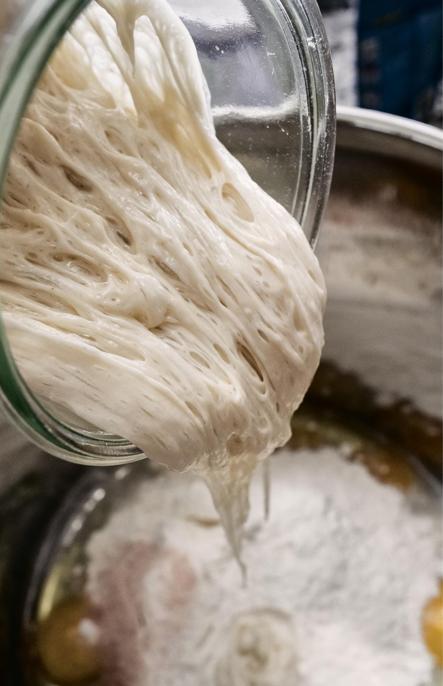
NGỌT NGÀO levain (levain) (NGỌT NGÀO men cái sourdough (starter))
Một số công thức nấu ăn trong cuốn sách này (Brioche lên men tự nhiên, trang này , hoặc Naan, trang này , chẳng hạn) dựa vào cái thường được gọi là men cái sourdough (starter) ngọt ngào hoặc levain (levain) ngọt ngào. Lần đầu tiên tôi biết đến cách chuẩn bị levain (levain) này từ Ian Lowe, một thợ làm bánh đầy cảm hứng tại tiệm bánh A Piece ở Úc. levain (levain) có nguồn gốc từ việc sản xuất bánh panettone của Ý (sử dụng đường trong khối bột (dough) đầu tiên, hoặc bước đầu tiên ). Để tạo ra món levain (levain) ngọt, hãy thêm đường, thường là 20% đến 25% tổng lượng bột trong levain (levain), vào hỗn hợp levain (levain). Việc thêm đường sẽ ngăn chặn sự phát triển của vi khuẩn, điều này làm thay đổi hương vị của món nướng cuối cùng theo hướng có vị chua tối thiểu. Khi vi khuẩn phát triển ít hơn, nấm men sẽ phát triển mạnh, điều này làm tăng khả năng lên men của chúng và tạo ra sản phẩm cuối cùng có độ nở cao hơn và có kết cấu nhẹ hơn.
Tôi sử dụng cách tiếp cận levain (levain) ngọt ngào một cách tiết kiệm và chỉ khi nó có ý nghĩa. Xét cho cùng, chúng tôi đang làm bánh mì lên men tự nhiên và chúng tôi muốn có một chút vị chua và axit — điều này tạo ra bánh mì có hương vị thơm ngon! Nhưng trong một số trường hợp, chẳng hạn như với khối bột (dough) được làm giàu (như Bánh rán Ý, trang này ), levain (levain) ngọt ngào là một cách cực kỳ hiệu quả để giảm nồng độ axit tổng thể.
Cũng giống như trường hợp của các loại levain (levain) khác, hãy nhớ sử dụng levain (levain) ngọt khi nó chín. Nó sẽ có mùi thơm ngọt ngào, cực kỳ sủi bọt và thường có độ phồng đáng kể (hãy nhớ sử dụng hộp đựng lớn khi làm để tránh tràn).
ĐIỀU GÌ NẾU levain (levain) LÊN THIẾU TRỌNG LƯỢNG ĐƯỢC LIỆT KÊ TRONG CÔNG THỨC THẾ NÀO?
Tùy thuộc vào mức độ cảnh giác của bạn khi cạo thìa, lọ và nắp đậy, bạn có thể thấy levain (levain) mà bạn tạo ra thiếu vài gam so với trọng lượng được liệt kê trong công thức. Điều này là ổn và được mong đợi. Trong hầu hết mọi trường hợp, đây không phải là vấn đề, bạn chỉ cần thực hiện theo công thức đã nêu. Nếu bạn thấy quá ngắn, có thể là 20g hoặc hơn, hãy sử dụng bánh mì men tự nhiên (sourdough) men cái sourdough (starter) (nếu nó chín vào thời điểm đó) để lấp đầy khoảng trống hoặc kéo dài thời gian ủ khối (bulk fermentation) của bạn để khối bột (dough) thêm một chút thời gian lên men.
Levain
A LEVAIN (PRONOUNCED LUH-VOHN), ALSO called a leaven, is made from a small portion of sourdough starter, and as you might guess from its name, it’s responsible for leavening your dough (making it rise). It’s a pre-ferment, which essentially means it’s flour that is fermented ahead of mixing into a dough (and unlike your starter, the entirety of the levain you make gets used). A levain helps you ensure your dough will start fermentation with strong populations of beneficial bacteria and wild yeasts, and it also lets you adjust the ratio between the two (see Tinkering with Sourness, this page ). When mixed into the main dough, the levain seeds it with the beginnings of fermentation. These microbes are responsible for leavening the dough, giving it exceptional storage qualities, and for much of the flavor in the final loaf of bread (thanks to the by-products of natural fermentation).
Why Make a Levain?
If you have a well-maintained sourdough starter, making a levain is not strictly mandatory (you can always just use your starter!). However, I learned to bake sourdough bread using a levain for each bake, and over the years I’ve found just how helpful it is for home bakers to get in the routine of making one for a particular bake. A levain serves a few purposes:
It can be used to alter the flavor, texture, and potential volume of the final loaf without having to modify your sourdough starter. Think of it as a custom-made starter for each recipe you embark on. A levain can skew the flavor profile of the bread toward more sour or less sour by altering its “build parameters”: the flour used, the inoculation or seed percentage (the amount of ripe starter used to make the levain), the time it takes to ripen, and its temperature. I also like that it helps make my recipes consistent for other bakers: Since people maintain (and sometimes neglect!) their starters in all sorts of ways, building a levain means we’re all starting on the same page.
It can be used to scale up the pre-ferment to cover recipe requirements. If your recipe calls for a large amount of pre-ferment, a levain allows you to scale up the pre-ferment in a single step to cover the recipe’s requirements. Some bakers prefer to keep a much smaller starter (see Maintaining a Smaller Starter, this page), so a levain helps bridge the gap between a small, continually maintained starter and a recipe’s pre-ferment requirement.
Because a levain is mixed in a separate small jar, you won’t accidentally use all your starter—and possibly forget to refresh it. This is perhaps a minor concern for some, but I do prefer to keep my pre-ferment for the day’s bake separate. Right after I use my ripe starter to make a levain, I refresh my starter and put it away for the rest of the day.
MAKING A LEVAIN
Starter Refreshment Cycle (see this page )
Levain vs. Starter: What’s the Difference?
A sourdough starter and a levain are, at their core, the same thing: They are both pre-ferments.
However, there are a few key differences. In this book, I use the term “starter” to refer to my continually maintained sourdough culture. Some might call this their chef, lievito madre , mother culture, mum, mother dough, and so on. My starter is never used completely in a bake because then I wouldn’t have any left to continue its propagation. It’s on a continuous cycle of ripening where it’s refreshed and left to ferment for some time until ripe again, at which point it can be used to mix into a dough, or create a new levain, or can be refreshed to continue the cycle.
A levain, on the other hand, is created with some portion of a ripe sourdough starter, left to ferment for a period, then used in its entirety in the dough mixed that day. Since it’s a branching from a sourdough starter and created for a single use, it can be used to adjust fermentation characteristics (e.g., increased or decreased sourness).
| SOURDOUGH STARTER | LEVAIN (LEAVEN) |
| A pre-ferment | A pre-ferment |
| Ongoing culture, refreshed regularly | Used once for a single bake |
| Usually refreshed with the same flour and kept at approximately the same temperature | Can be any flour combination and the temperature can change |
| Mostly consistent characteristics (acidity/flavor profile) because it’s maintained in a consistent manner | Can be used to change the flavor and texture of a single batch of dough |
Can I Just Use My Sourdough Starter Instead of Making a Levain?
All the recipes in this book use a dedicated levain for the reasons already discussed (to adjust the flavor profile, modify the timeline of the bake, and scale up the pre-ferment), but if you’ve forgotten to make a levain and really want to bake, just use your ripe starter! It will mean a different flavor profile if the levain is a drastically different build (different flour, hydration, and temperature), but it’s better than not baking at all. Just be sure you don’t use your entire sourdough starter in the bake—as always, save a little to keep your culture going.
What Flour Should I Use for My Levain?
Any fermentable flour can be used for making a levain, from white to whole wheat to grains such as spelt, einkorn, or Khorasan. I have a set of go-to flour choices, depending on my desired outcome for the levain, and each brings different properties to the levain, the final dough, and subsequently, the finished loaf of bread. Note that the resulting loaf of bread will not taste like the levain itself; it is simply the seed to start fermentation.
Generally, I prefer my levain to be made up of at least 50% whole grains. Pairing whole-grain flour with sifted white flour leads to a balanced levain with ample flavor and leavening power. Adding whole-grain flour allows the levain to take on more acid before bacterial activity drops, which means an overall increase in organic acids and other flavor compounds. The 50% white flour balances out the whole wheat, keeping it milder by preventing the acidity from increasing too dramatically. Of course, you can go to either end of the spectrum as well: a 100% white flour levain (like the one in Soft White Sandwich Bread, this page ) leads to greatly reduced acidity, while a 100% whole-grain levain (like the one in 100% Whole Wheat, this page ) brings more acidity and flavor complexity.
When Is a Levain Ready to Use?
Like a sourdough starter, a levain ferments (or ripens ) over time. At either end of this continuum, you have a mixture that isn’t ideal for use in making bread. At the start, there are insufficient bacteria and yeast populations, and it’s essentially raw flour and water with a small seed of ripe sourdough starter. At the other end of the continuum, you have a mixture that’s very acidic, broken down, and loose, as fermentation has gone on for too long. There are no concrete times for this process because the duration will be highly dependent on the starter inoculation percentage (the amount of ripe starter added to the mixture), its final dough temperature after mixing it together (and the temperature at which it’s maintained), and the flour used. Regardless of whether the timeline is 3 hours or 20 hours, every levain still travels along this continuum, passing through these states as fermentation progresses.
First, let’s step back and look at what’s happening during the life of your levain. At the onset, a measure of flour and water is seeded with a percentage of a ripe sourdough starter—commonly called the seed percentage or inoculation percentage. Once this is mixed, fermentation begins: The beneficial bacteria and wild yeasts start to metabolize the new food source (the sugars in the flour), increase their numbers, and produce the by-products of fermentation (organic acids, gasses, etc.). As fermentation progresses, your levain mixture will begin passing from “just mixed” to “young” to “ripe” to “overripe.”
A levain (and a sourdough starter, for that matter) can be used at many points in the ripening continuum: from a few hours after mixing all the way to when the levain is extremely ripe, or even overripe. The point at which you opt to use the levain is a personal choice and has implications for the rest of the bake. My preference is to use my levain when it’s just ripe; it will have bubbles on top and at the sides, a looser consistency, and a sour aroma. Remember, this ripening timeline is a continuum with no discrete points along the path and with no best time for using your levain. Like knowing when to use your starter, it’s more about learning to read the signs for ripeness and what the effect will be if you use it a little on the young side or a little on the overripe side. And if you’re a little off in one direction or the other, don’t worry about it, you can always adjust down the line by reducing or lengthening bulk fermentation, the proof, and other baking parameters.
For a description and look at each stage when a levain is ripening, flip to this page , where this is shown for a sourdough starter. Many of the characteristics—aroma, taste, visuals, and consistency—will generally be very similar (assuming the two have the same hydration percentage).
Can You Use a Levain Before or After It’s Ripe?
Ideally, you use a levain at the right time (when it’s ripe), but it is also very forgiving! If you use your levain early, expect the fermentation activity to be sluggish because of the reduced populations of bacteria and yeasts. As you assess the dough’s progress during bulk fermentation, you may need to delay the divide time. Conversely, a riper levain will have increased fermentation activity and might require an earlier divide. At the far end, if you find your levain is drastically overripe—it has a sharp sour aroma bordering on nail polish and a thin, broken-down consistency like runny pancake batter—then create an intermediate levain (see next paragraph).
Spotting the signs of levain ripeness and learning to adjust later in the breadmaking process will come as you bake more and gain experience. In general, you’re going to find much better results with an overripe levain than an underripe one, so if you’re not totally confident about your skills in reading the signs of ripeness, err on the side of overripeness!
Remember to always create your levain from a ripe sourdough starter to begin with strong bacteria and yeast cell populations.
Intermediate Levain
Sometimes if I can’t get to using my levain when scheduled and it becomes very overripe and extremely acidic, I’ll mellow it out with what’s called an intermediate levain build. A convenient approach is to make a fast 3- to 4-hour levain at the same hydration with an inoculation percentage of 100% (see Baker’s Percentages, this page ).
For example:
| INGREDIENT | ORIGINAL LEVAIN (NOW OVERRIPE) | INTERMEDIATE LEVAIN (NEW 3-HOUR BUILD) |
| Flour | 100g (100%) | 100g (100%) |
| Water | 100g (100%) | 100g (100%) |
| Sourdough starter or previous levain | 10g (10%) sourdough starter | 100g (100%) overripe levain |
Using some of the overripe levain, at 100% to total flour in the new levain, will mean faster ripening to quickly get you back to baking. Be sure the total quantity of the new levain will cover your requirements and keep it warm, around 78°F (25°C), to ensure it’s ready in 3 to 4 hours.
Levain + Dough Temperature
In the same way a dough is mixed to a desired dough temperature (DDT)—see Final vs. Desired Dough Temperature ( this page ) for more—a levain is also mixed to an ideal final temperature to adhere to a timeline and promote a particular balance of bacterial activity versus yeast activity. In general, the levain builds in this book will target 78°F (25°C), with only a few exceptions (such as Roggenvollkornbrot, this page ).
Levain Hydration
Regardless of whether you maintain a liquid starter (usually around 100% hydration and above) or a stiff starter (usually 50% to 65% hydration), you can always use your existing starter to make any of the levains in this book. It’s not necessary to “convert” your starter to a different hydration, just be mindful of the hydration: All the levain builds and recipes in this book assume you are working with a 100% hydration sourdough starter, so if you maintain a stiff starter, you might need to add extra water to the newly created levain or dough mix.
My Three Levain Types
There are many ways to make a levain, but in my baking, and as used throughout this book, I turn to three main classes: a liquid levain, a stiff levain, and a sweet levain. Each type has a benefit and specific purpose; let’s look at each.
LIQUID LEVAIN
Many recipes in this book use a liquid levain, that is, one that’s around 100% water to total flour. I find a liquid levain to be a well-rounded approach to creating a pre-ferment and it’s what I turn to most often: It’s mild (if used at the right time) in both aroma and acidity, it can help bring added extensibility to the dough (which helps if the dough is composed of a high percentage of strong white flour), it’s easy to mix, and it’s easy to assess fermentation progress.
STIFF LEVAIN
Some recipes in this book call for a stiff levain (e.g., Miche, this page ), which is anywhere between 50% and 65% hydration and mixes up to a firm consistency. The following are some beneficial properties of a stiff levain. (Note that this does not mean a stiff levain is superior to a liquid levain; it’s just a different approach to making a pre-ferment with a certain set of characteristics.)
Additional dough strength: A stiff levain adds a noticeable measure of elasticity to a dough due to its lower water content. I find this added strength useful for whole-grain loaves, especially those with high percentages of freshly milled flour.
Wider usage window: A stiff levain reduces bacterial activity, which results in less acidification. This helps prevent a levain from quickly becoming overly acidic. Because of this, I find a stiff levain to be more flexible, especially for days when it’s warmer than expected or to help with deviations in my schedule. In my experience, a stiff levain has a usage window of at least 3 hours if fermented overnight, and 1 to 2 hours if fermented the same day.
Different flavor by changing acid balance: With a stiff levain, I use a high percentage of whole-grain flour (usually 100%). This flour choice, coupled with a decrease in hydration in the levain, emphasizes a more up-front flavor profile. This is in part due to the increase in substances in whole wheat flour that are used by bacteria to generate acetic acid. Further, whole-grain flour can take on more acid before the pH drops enough to reduce bacterial activity.
SWEET LEVAIN (SWEET STARTER)
Some recipes in this book (Naturally Leavened Brioche, this page , or Naan, this page , for example) rely on what’s commonly called a sweet starter, or sweet levain. I first learned of this levain preparation from Ian Lowe, an inspiring baker at Apiece bakery in Australia. The levain has roots in Italian panettone production (which uses sugar in the first dough, or primo impasto ). To make a sweet levain, add sugar, usually 20% to 25% of the total flour in the levain, to the levain mix itself. Adding sugar suppresses bacterial growth, which skews the flavor profile of the final baked good toward minimal sourness. With less bacterial growth, the yeasts are left to flourish, which increases their leavening power and results in a final product that rises higher and has a lighter texture.
I use the sweet levain approach sparingly and only where it makes sense. After all, we’re making naturally leavened bread and we do want some acidity and sourness—this creates flavorful bread! But in some cases, such as with enriched dough (like Italian Doughnuts, this page ), a sweet levain is an incredibly effective way to reduce overall acidity.
Just as is the case with other levain types, be sure to use the sweet levain when it’s ripe. It will have a sweet aroma, be extremely bubbly, and usually display significant rise (be sure to use a large container when making it to avoid overflow).
WHAT IF THE LEVAIN COMES UP SHORT OF THE WEIGHTS LISTED IN THE RECIPES?
Depending on how vigilant you are about scraping your spatulas, jars, and lids, you might find the levain you make comes up a few grams short of the weights listed in the formulas. This is okay and expected. In almost every case, this is not a problem, just proceed with the recipe as outlined. If you come up excessively short, perhaps 20g or more, use your sourdough starter (if it’s ripe at that time) to fill in the gap or extend your bulk fermentation time to give the dough a little more time to ferment.